Designing 5 user roles into one nationwide arts events platform
Summary
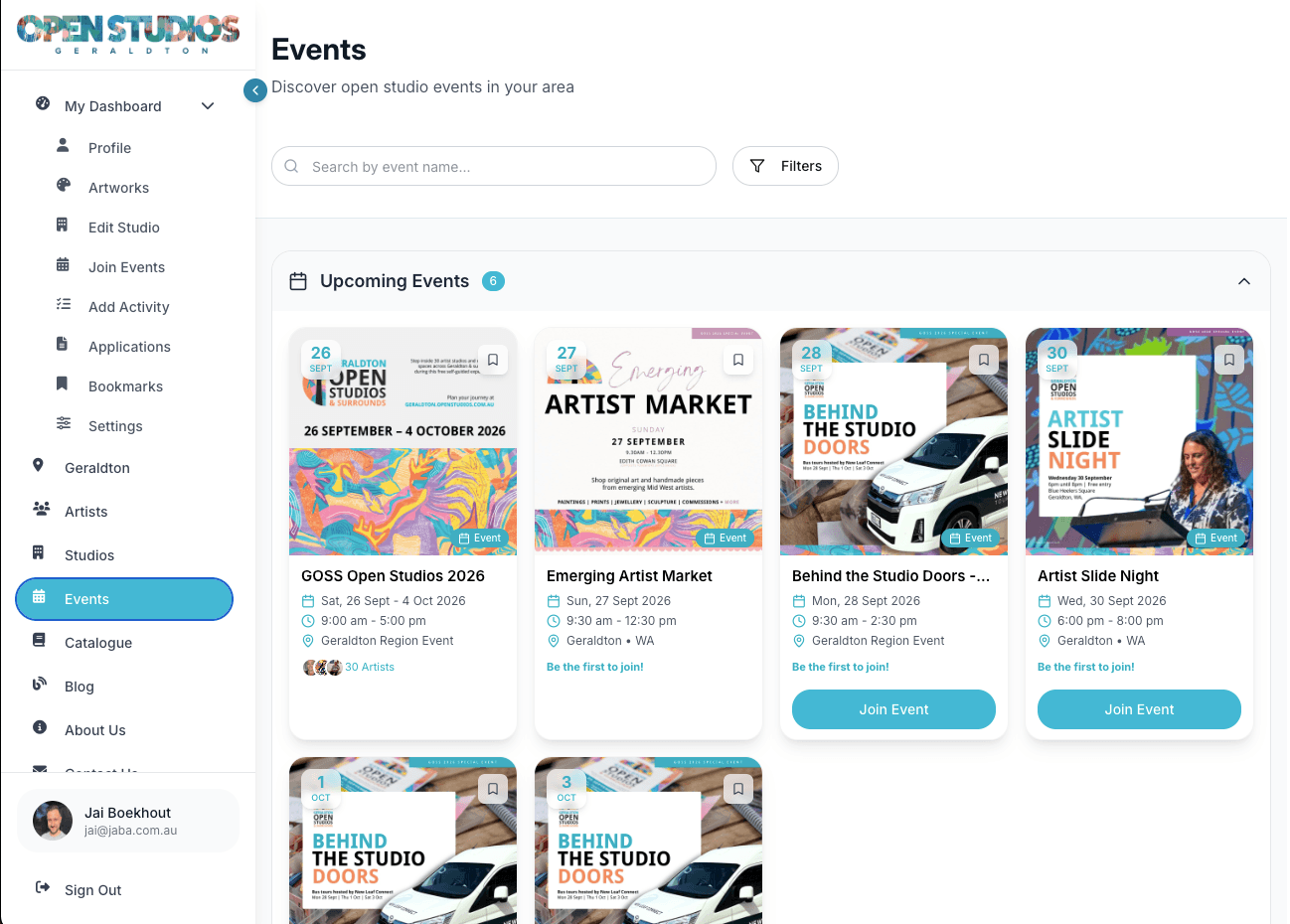
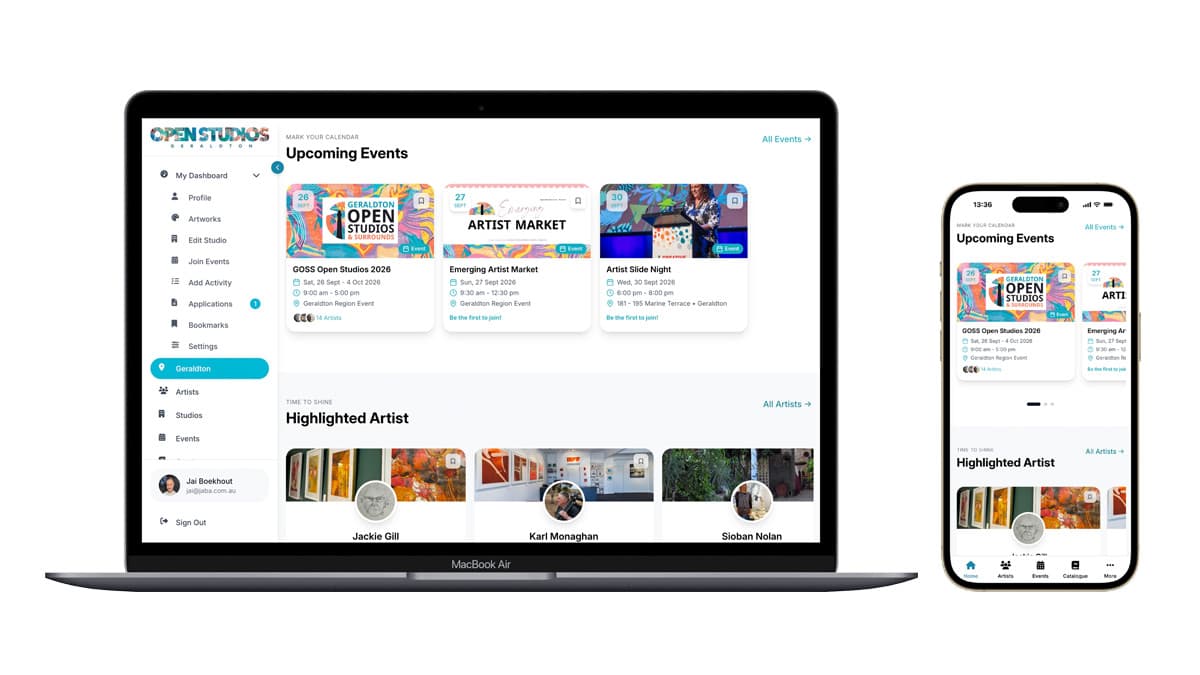
Open Studios Australia is a nationwide digital platform designed to connect visitors with artists, studios and creative events across the country. The project reimagines the traditional Open Studios experience with a centralised, mobile-first application where people can discover local creative communities, explore studios, attend activities and workshops, and browse curated catalogues. My role covered concept development, user experience design, Object-Oriented UX (OOUX) structuring and interface prototyping, as well as developing the web app using AI-assisted development, with support from JABA's tech team. The platform was built with a strong focus on user experience and accessibility, so visitors, artists, studio owners and licensees all have tools tailored to their needs.
Role

Role
App & Platform Design, Project manager & Development (AI)
JABA Web Design Client
Open Studios Australia
Platform
Custom web app (AI-assisted development)
Scope
UX and system design, OOUX mapping across 5 user roles, approval-gated workflows, purpose-built dashboards, catalogue generation tool, AI-assisted development
Project Detail
Open Studios Australia is a nationwide platform connecting art lovers with artists, studios, and creative events across the country. The client needed to replace a process held together by spreadsheets and email threads with a single platform capable of serving multiple regions simultaneously.
I worked on the project from early research through to build, covering user research, system design, UX flows, UI design and AI-assisted development, with support from JABA's tech team on the more complex elements. The platform handles artist onboarding, multi-party event applications, regional administration and event catalogue generation, all from one unified system.
Process
The Problem
Every regional open studios organisation is running events differently. Artists were manually sending bios and information for every event they joined. Organisers were chasing applications, cross-checking details, and building printed catalogues by hand. Art lovers had no reliable way to find events or follow artists they cared about. And because every region operated independently with no shared infrastructure, there was no realistic path to scale.
The challenge extended well beyond the interface. The project required designing a system capable of holding five distinct user types, complex multi-party workflows, and regional independence within a shared platform, while keeping the experience genuinely simple for every person using it.
Understanding the Users
Before any screens were designed, five distinct user roles were mapped out along with what success looked like for each one.
Role | Core Need |
|---|---|
Public visitor | Discover artists, events, and studios |
Art lover (member) | Save favourites, plan visits, follow artists |
Artist | Showcase work, apply to events, add activities to events and collaborate with other artists |
Licensee (regional org) | Manage events, review applications, create catalogues |
Super Admin | Cross-region oversight and platform governance |
Treating each role as having genuinely different goals and mental models shaped every decision that followed, from navigation structure and permission logic through to database schema and dashboard design. A single generic admin experience was never an option.
Structuring the System with OOUX
With five user types and deeply interconnected content, Object-Oriented UX methodology was used to define every core object in the platform before a single screen was designed. Artists, Artworks, Studios, Events, Activities, Workshops, Applications, Catalogues, Blogs, Regions, and Maps were each fully mapped with their attributes, relationships to other objects, and the actions each user role could perform on them.
This process delivered two critical outcomes. It gave the system a consistent internal logic where content entered once flows to every part of the platform that needs it, without duplication or manual re-entry. And it surfaced the most complex design problem early, before it had the chance to become a development problem.
The Participation Problem
Artists can join an event three ways. Independently at their own studio, as a host who invites guest artists to share their space, or as a guest displaying at another artist's studio. Each path introduces dependencies that compound quickly.
A guest cannot apply until a host is confirmed. A host withdrawing affects every guest connected to them. Organisers need to review these relationships without getting buried in edge cases. And the system needs to handle scenarios like a guest applying to a host who has not yet joined the event, or a host withdrawing after their guests are already approved.
A conditional, approval-gated workflow was designed to cover all three participation paths. Every decision point, system prompt, approval state, and failure condition is accounted for, including auto-close rules for lapsed invitations, cascading withdrawal logic, and the ordering dependency between host and guest approvals.
A second workflow covers activity applications, for artists proposing workshops, demonstrations, or talks during an event. This handles collaborative activities with multiple co-hosts, invitation lapse rules, draft and live versioning for approved activities requiring updates, and withdrawal logic that cascades correctly when a host exits mid-event.
Both workflows feed into the same regional team review interface, giving licensees a single consolidated view of all pending decisions regardless of application type.
Dashboards Built Around Real Workflows
Each user type received a purpose-built dashboard designed around their actual tasks and goals, not a generic admin panel with permissions added on top.
Artist Dashboard
Events are organised into four clear rows: attending, invited, suggested, and history. Artists have a complete picture of their current and upcoming participation at a glance. Collaboration is built into the activity submission flow, addressing the very real barrier that solo hosting creates for emerging artists.
Licensee Dashboard
Application management, artist search, event creation, catalogue generation, and content publishing are all consolidated in one place. The applications view opens filter-first so licensees land on a sorted, manageable list rather than an unstructured inbox. Artist search includes sorting by event participation count and follower count, supporting both new artist discovery and the management of existing relationships.
Super Admin Dashboard
All licensee capabilities are available, with the addition of a licensee selector dropdown. This single feature enables full platform management across every region from one interface, without requiring separate environments for each. The approach keeps the system lean and avoids duplicating infrastructure across regions.
The Catalogue Tool
Licensees were producing event catalogues manually, with no consistent process and significant time investment. The catalogue tool generates directly from existing event data. A custom cover, advertisements, artist highlights, and a thank-you page can all be added within the tool. The output is both a digital catalogue with interactive maps and a print-ready PDF.
Because artist data flows from onboarding into every relevant part of the platform, there is nothing to re-enter and nothing to chase. What previously took hours now takes minutes.
Iteration After Testing
Testing identified that licensees and super admins lacked a central location to manage platform content. The settings area was redesigned as a tabbed content management system, with each tab corresponding to a specific section of the site and surfacing only the controls relevant to that section.
Two further changes came directly from testing. A Highlighted Artists feature was introduced, allowing admins to manually pin and reorder up to four featured artists on the homepage, with remaining slots filled automatically by the platform. The Add Event workflow was also rebuilt with smart time defaults, flexible location options including the ability to pull studio locations directly from approved artist applications, and artist invitations integrated into the creation flow rather than managed as a separate step.
Development
Developed the platform using AI-assisted development tools, working directly from the UX designs and system maps, with support from JABA's tech team on some of the more complex development elements. Because the system had already been mapped with OOUX, each object, relationship and user permission translated directly into the build, which kept design and development closely aligned.
Being both designer and developer meant design decisions could be tested in the real product early, and issues found during testing could be fixed quickly rather than waiting in a backlog. The platform includes subscriptions, map-based studio locations and notifications, all designed around the same five user roles.
Reflection
This project was not a UI refresh or a visual rebrand. It was a product designed from first principles, starting with a clear understanding of who the users are, mapping every object and relationship in the system before a screen was touched, and resolving the most complex workflow problems before visual design began.
The decisions that had the greatest impact were structural. How participation dependencies are validated. How content flows through the system without duplication. How five very different user types share one platform without any of them feeling like a secondary consideration.
That is the standard this project was held to throughout.