Discovereye: turning the human eye into a telescope to the stars
Summary
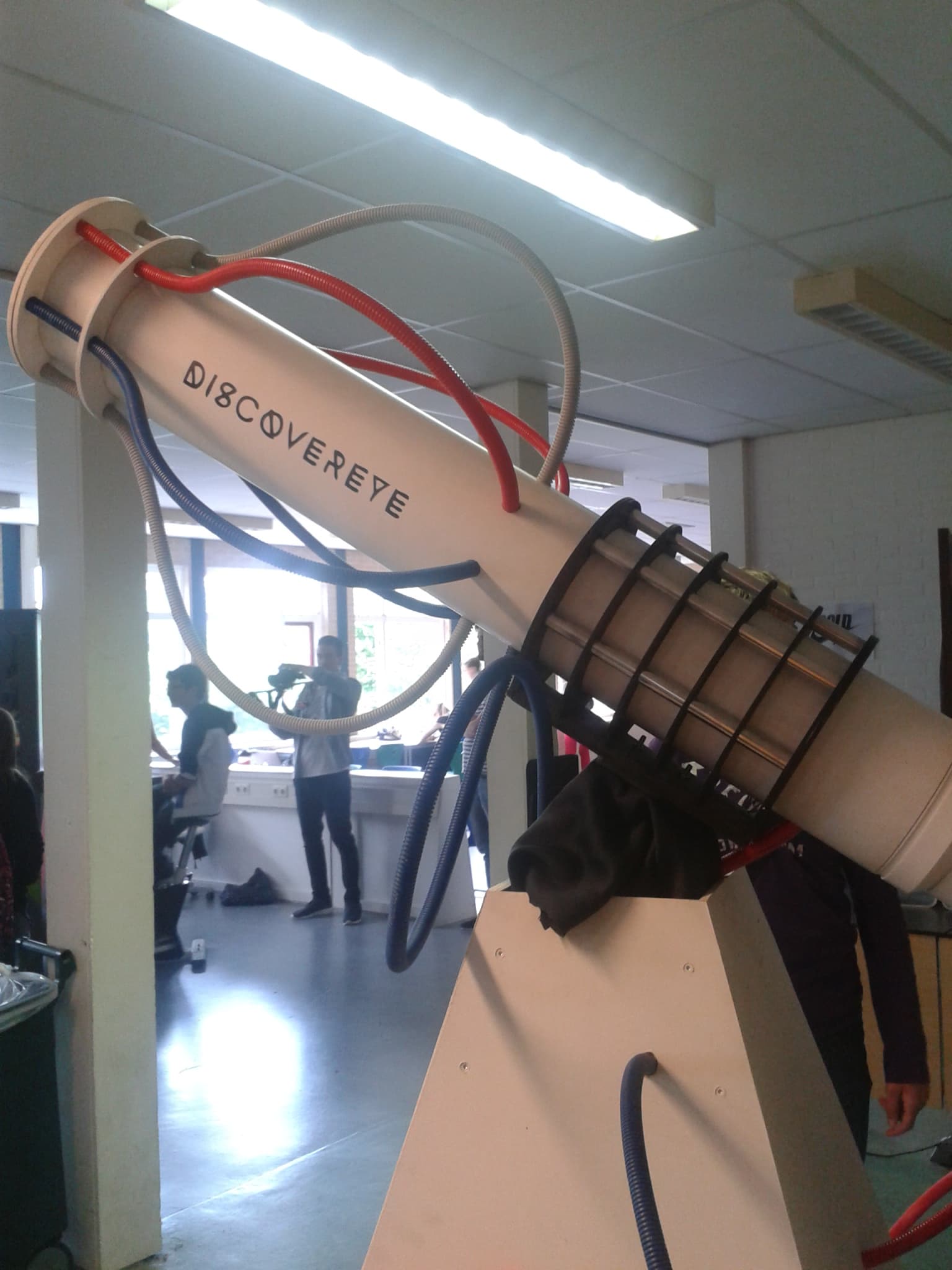
A 3rd-year university brief from Discovery Channel Netherlands: build a fully working interactive installation in six weeks that inspires children. My team built Discovereye, a goggle that connects the viewer's own eye to a live video of planets and galaxies, tying the idea that we're all made of stardust back to something you can look through and see for yourself. It placed 2nd out of 25 installations.
Role
Role
Concept Development & Installation Design (Team Project); Poster Design & Photography (Individual)
Client
Discovery Channel Netherlands (Avans University brief)
Platform
Physical interactive installation (goggle, digital microscope, video loop)
Scope
Concept development, interactive installation design and build, exhibition poster design, photography
Project Detail
During my 3rd year at Avans University, Discovery Channel Netherlands set a brief for the class: design and build a fully working interactive installation, in six weeks, that would inspire children. The winner would receive a budget to develop their installation further and be showcased at the Discovery festival in Amsterdam.
My team started from a video of astrophysicist Neil deGrasse Tyson explaining that everyone on Earth is made of stardust, the same atoms found in every star and planet in the universe. That idea led us, through a series of brainstorms, to the concept of a telescope that let people look outward at the rest of the universe. Since we already look at the world through our own eyes, we took that literally and made the iris the starting point of the design.
Process
The Concept
After testing several digital cameras to photograph our own eyes and experimenting with ways to make the experience interactive, we landed on a digital microscope for the extra zoom it gave us, this turned out to be the crucial piece of the installation. To connect the stars and planets in the universe back to the people looking at them, we built a video loop of planets and galaxies drifting through space, viewed through a goggle we built with two parts: a small screen showing the video footage, and, on the other side, a microscope filming the viewer's own eye. Turning a large focusing knob on the housing lets the viewer 'zoom in', slowly transitioning the video from planets and galaxies to a 20x zoomed-in live feed of their own iris, connecting the person looking to the universe they're looking at.
How Does It Work?
Step 1: the viewer looks through the goggles and sees a video of planets and galaxies drifting past.
Step 2: turning the focusing knob on the side of the housing zooms in and out, changing the video footage as they go.
Step 3: a USB microscope inside the goggle is constantly filming the viewer's eye. That footage overlays the planets once the viewer has zoomed all the way in, completing the connection between them and the universe.
Poster Design
Alongside the installation, I shot a set of posters on a DSLR and a drone, sourced secondhand through Etsy.
Camera: Sony A77, GoPro Hero 8.
Drone: DJI Mavic Pro, DJI Mavic Air 2.